What to Look for in a Private, On-Device Snore Tracker
The real difference in any snore or sleep tracker is where your audio goes and what you have to give up to use it. Here is a short checklist to run before you install anything.
Published Updated
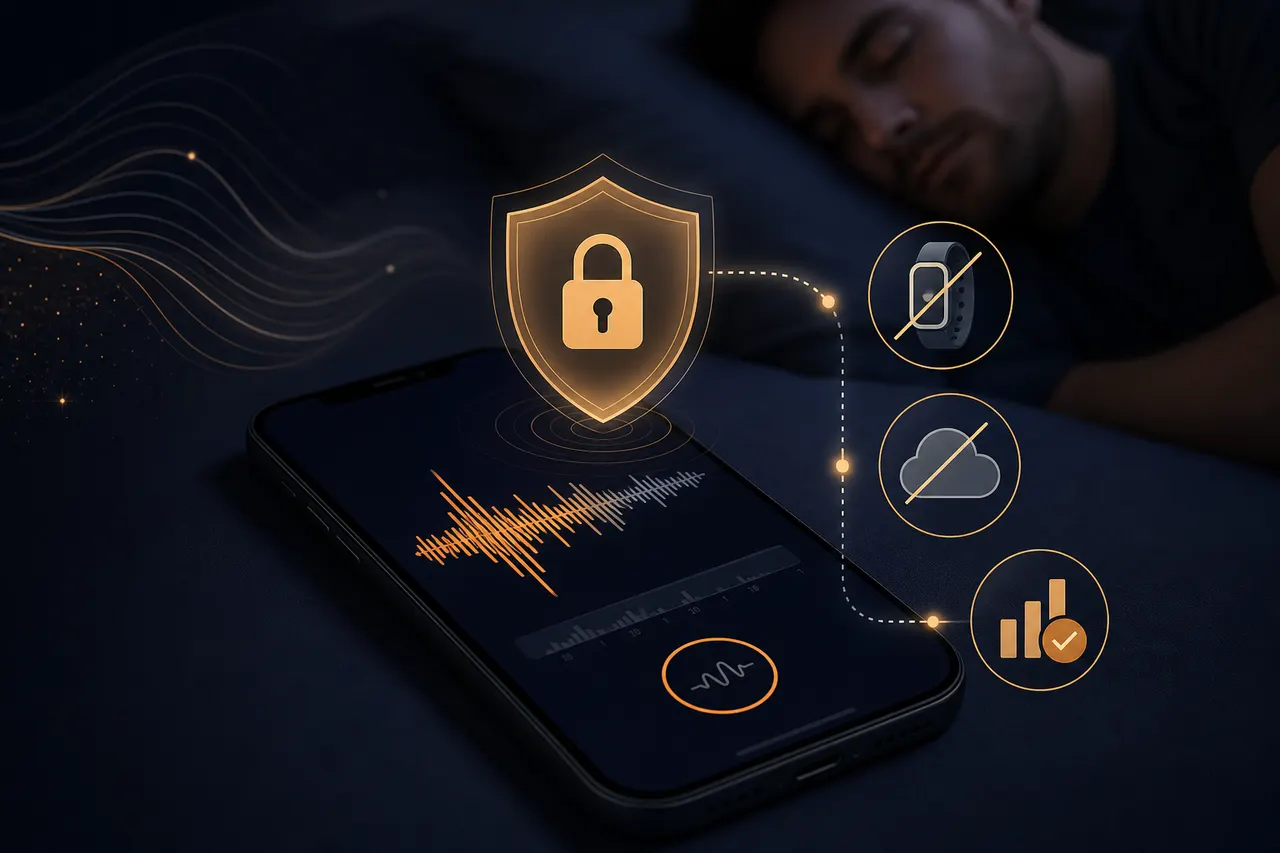
There are a lot of ways to track snoring now, and they’re not all the same underneath. The real difference isn’t the interface. It’s where your audio goes and what you have to give up to use the thing. Here’s a short checklist you can run against any snore or sleep tracker before you install it.
Start with one question: where does your audio go?
Everything else follows from this. An app either does the work on your phone, or it ships your night off to a server. Once you know which one you’re dealing with, the rest of the decision gets easy.
Checklist item one: does it need a wearable?
Some trackers only work if you wear a ring or a band, or slide a mat under the mattress. That’s one more thing to charge, one more thing to replace, and one more place your data lives. A phone-based tracker skips all of that and uses hardware you already own.
Checklist item two: does it require a cloud account?
Watch for apps that won’t do anything until you make an account. An account is usually a sign your data is being stored somewhere off the phone. If the tool can run without a login, that tells you something good about how it treats your information.
Checklist item three: how is the nightly number made?
A tracker should be able to explain, in plain words, how it gets from a night of sound to whatever score it shows you. If it can’t, stay skeptical. You want a number tied to your own nights, not a rating pulled from a population average.
How Nightsong fits the checklist
Nightsong runs on the iPhone by itself. No wearable, no cloud account, and your recordings never leave your phone. It listens through the mic, sorts your breathing and snoring out of the night, and hands you one score each morning, the Somnus Index, measured against your own baseline.
It’s a wellness tool, not a medical or diagnostic device. iPhone only, in TestFlight beta now, with a full public launch targeted for fall 2026.
Questions people ask
What should I ask before using a snore-tracking app?
Ask whether it needs a wearable, whether it makes you create a cloud account, and where your audio actually gets processed.
Is Nightsong a diagnostic tool?
No. Nightsong is a wellness tool that gives you a nightly score. It is not a medical or diagnostic device.
Why does it matter whether an app requires a cloud account?
An account usually means your data is stored somewhere other than your phone. If the app can run without a login, that is a signal it keeps your information local.
What is the Somnus Index?
It is the nightly wellness score Nightsong produces each morning, built from how steady your breathing was and how much you snored, measured against your own baseline rather than a population average.
Do I need to buy anything extra to use Nightsong?
No. Nightsong uses the iPhone you already own. There is no ring, band, or under-mattress sensor required.
When will Nightsong be publicly available?
It is currently in TestFlight beta, with a full public launch targeted for fall 2026.
What makes a phone-based tracker different from a wearable?
A phone-based tracker uses hardware you already own, with no extra device to charge or replace. It also means one fewer place your data could end up.