Best Snoring Tracker Apps for iPhone in 2026 (No Wearable Required)
Your iPhone's microphone is a capable sleep sensor. Here is a head-to-head look at five apps worth considering in 2026, what each does well, and who each is actually built for.
Published Updated
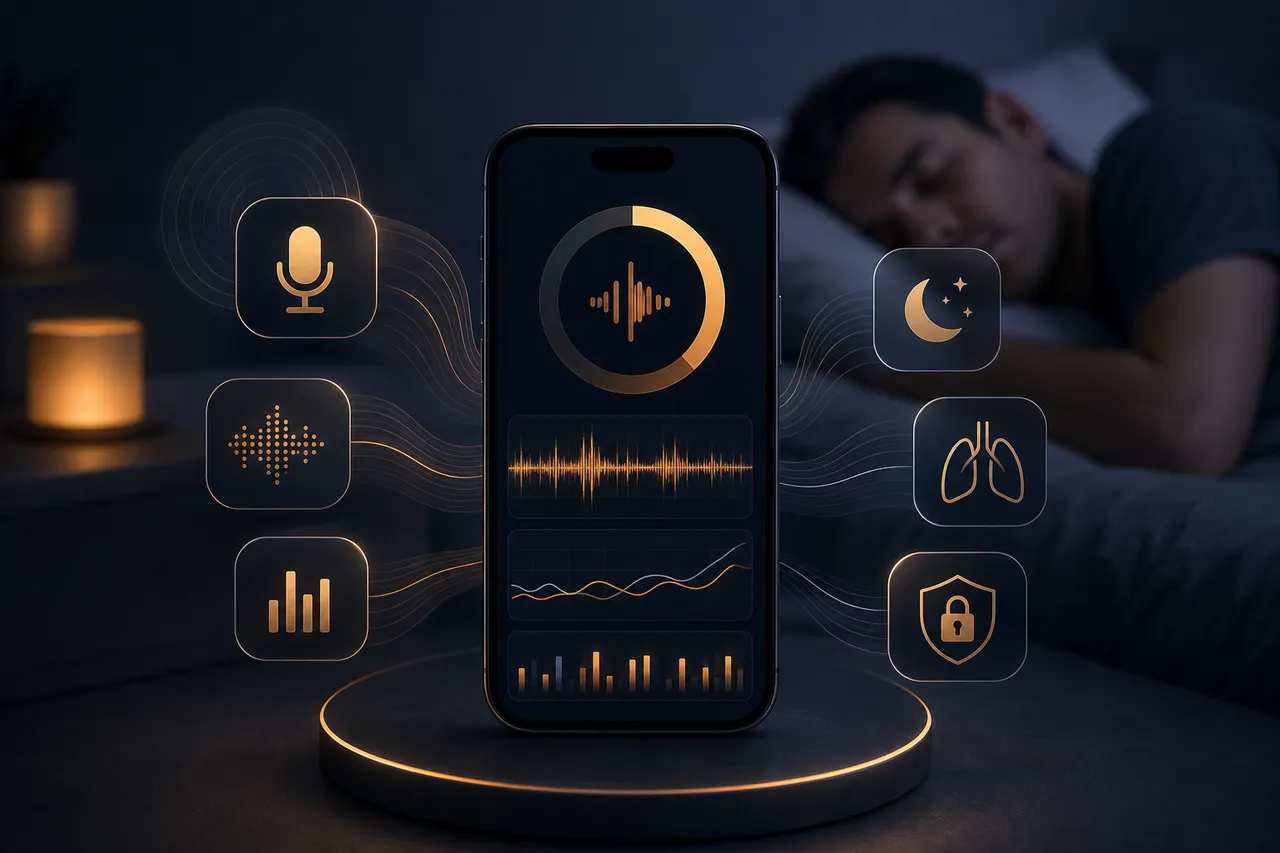
Your partner says you snore. Or you wake up groggy after a full eight hours and want to know why. Either way, you’ve landed on the same question thousands of iPhone users are asking right now: which snoring tracker app is actually worth using?
The good news is you don’t need a $400 smart ring or a chest strap to get useful data. Your iPhone’s microphone is a capable sensor, and several apps have built their entire product around it. The harder question is which one to trust with something as personal as the sounds of your breathing at night.
This guide breaks down the five most relevant apps in 2026: what each does well, where each falls short, and who each is actually built for. No filler, no vague star ratings.
What to Look for in a Snoring Tracker App
Before diving into the comparison, it helps to know what actually separates a useful app from a mediocre one.
Accuracy over flattery. Some apps smooth out a bad night or present your data in ways that feel more encouraging than informative. That’s not useful data. You want an app that reports what it actually heard.
Privacy. Your breathing sounds are health data. Does the app upload your audio to a server? If so, whose? Under what terms? These are fair questions, and the answers vary significantly across apps.
A score you can act on. Raw audio clips are interesting once. A trend line you can watch over weeks is genuinely useful. The best apps give you a single number each morning and show you how it moves over time.
No hardware requirement. If you need to buy something before the app works, that’s a meaningful barrier. The apps below all work with just your iPhone, though some offer optional integrations with Apple Watch.
The Apps: Head-to-Head
SnoreLab
SnoreLab is the category’s incumbent. It has monitored over 50 million nights, logs roughly 1 million nights per month, and sits in the top four grossing apps in the Medical category on the US App Store. If you’ve searched for a snoring app before, you’ve probably seen it.
The core feature is the SnoreScore, a single nightly number that summarizes how much and how loudly you snored. It was the app that created the mental model most users now expect from this category.
What it does well: The dataset is enormous, which helps with pattern recognition. It’s cross-platform (iOS and Android), widely endorsed by sleep clinicians, and has a long track record. The interface is familiar to millions of users.
Where it falls short: SnoreLab’s optional cloud backup sends your audio to SnoreLab’s own servers. If you care about where your health data lives, that’s a real concern. The app also doesn’t analyze breathing patterns beyond snoring volume and frequency; there’s no respiratory steadiness metric or composite wellness framing. And the pricing is fragmented: in-app purchases range from $3.99 to $39.99, with an ad-supported free tier that can feel cluttered.
Best for: Snorers on iOS or Android who want a proven, widely recognized tool and are comfortable with some cloud data trade-off.
Pricing: Free with ads; premium up to ~$39.99/yr.
Snollo
Snollo is a solid, privacy-conscious option available today. It uses on-device AI for snore detection and stores audio only in the user’s own iCloud, not on Snollo’s servers, which is a meaningful distinction from apps that route data through third-party infrastructure. It also offers a free core tier with no consecutive-day recording restrictions.
It integrates Apple Watch sleep stages (REM, Deep, Light) alongside microphone-based snore detection, making it a hardware-optional hybrid. Its App Store rating is 5.0, suggesting strong early user satisfaction.
What it does well: The privacy architecture is thoughtful. Audio stays within your personal iCloud rather than a third-party server. The Apple Watch integration adds sleep stage context for users who already wear one. The free tier is genuinely usable.
Where it falls short: Snollo doesn’t offer a proprietary composite score. You get raw data and sleep stages, but there’s no synthesized nightly wellness number you can track over time at a glance. There’s also no plain-language Q&A feature; you can’t ask “was last Tuesday worse than my average?” and get a direct answer. Pricing beyond the free tier isn’t publicly listed, which makes it hard to evaluate the full value proposition.
Best for: Privacy-conscious iPhone users, especially Apple Watch owners, who want snore detection without surrendering audio to a third-party server and want a capable option they can use right now.
Pricing: Free tier available; paid tier pricing not publicly listed.
Sleep Cycle
Sleep Cycle is the dominant brand in no-wearable sleep tracking, with over 10 million downloads and consistent placement in “best sleep app” roundups. Its core differentiator is a smart alarm that wakes you during a light sleep phase, which genuinely reduces morning grogginess for many users.
Snoring recording is included as a feature, which means it overlaps with this category, but it is not Sleep Cycle’s primary focus.
What it does well: The brand is polished, the smart alarm is backed by real sleep science, and the subscription is well-established at $39.99/yr with a 7-day free trial. If you want a general sleep improvement app with a gentle alarm, Sleep Cycle is the most mature option.
Where it falls short: Snoring and breathing analysis are secondary features, not the core product. The app requires a cloud account, and your audio and sleep data leave your device. There’s no respiratory wellness score equivalent to what dedicated snoring apps offer, and no natural language querying of your personal data.
Best for: Mainstream users who want a polished sleep app primarily focused on waking up better, not understanding their breathing.
Pricing: ~$39.99/yr, 7-day free trial.
SleepScore
SleepScore takes a different technical approach: patented sonar technology that uses your phone’s speaker and microphone to measure breathing movement without contact. It claims 800 million hours of sleep data and 14 peer-reviewed validation papers.
What it does well: The sonar approach is genuinely novel, and the clinical validation is the most extensive of any app in this list. If scientific credibility matters to you, SleepScore has invested in it.
Where it falls short: The sonar technology requires your phone to be placed on the nightstand at a specific angle, which is a setup friction most users underestimate. On-device processing is limited, and the privacy story is weaker than apps built around local-only audio. There’s no composite respiratory wellness score and no plain-language data querying.
Best for: Users who prioritize clinical validation and don’t mind precise phone placement requirements.
Pricing: Free with in-app purchases; full pricing not publicly listed.
Nightsong
Nightsong is the newest entrant in this comparison and the one built most specifically around the gaps the other apps leave open.
The core product: your iPhone listens to your breathing and snoring all night. All audio processing happens entirely on-device. Your recording is never uploaded. Each morning you get a 0-100 score called the Somnus Index, which combines snoring minutes and breathing steadiness into a single honest number.
What it does well:
- On-device processing, no exceptions. Your audio never leaves your iPhone. There’s no server, no cloud copy, no opt-in backup that quietly sends data elsewhere. This is a structural privacy guarantee, not a setting. As Nightsong puts it: “We don’t track your steps. We track how you breathe and how you sleep, against your own baseline, not against a machine in the sky.”
- The Somnus Index. Rather than showing you raw audio clips or a simple snore volume bar, Nightsong synthesizes everything into one number you can track over 30 days. Your baseline is built from your own nights, so you’re measured against yourself, not a population average.
- Honest reporting. If you snored for 38 minutes, the app reports 38 minutes. No rounding, no flattering estimates.
- Ask Nightsong. An on-device Q&A feature lets you ask plain-language questions about your sleep history: “Was last week better than the week before?” You get answers grounded in your actual data. No other app in this category offers this.
- No wearable required. Your phone is the sensor. An Apple Watch can enrich the data if you wear one, but it’s never required to unlock any feature.
Where it falls short: Nightsong is in pre-launch as of mid-2026, which means it doesn’t yet have the track record or dataset that SnoreLab has built over years. An Android version is in active development, but Nightsong is currently iPhone only.
Best for: Privacy-conscious iPhone users who want a synthesized, trend-trackable score and honest breathing data without a wearable or a cloud account.
Pricing: Free to start; premium at $49.99/year.
Side-by-Side Comparison
| App | On-Device Only | Composite Score | Plain-Language Q&A | No Wearable Needed | Pricing |
|---|---|---|---|---|---|
| Nightsong | Yes | Yes (Somnus Index) | Yes | Yes | Free to start; $49.99/yr |
| SnoreLab | No (optional cloud) | Yes (SnoreScore) | No | Yes | Free to $39.99/yr |
| Snollo | Yes (iCloud) | No | No | Yes (Watch optional) | Free tier + unlisted |
| Sleep Cycle | No | Sleep stages only | No | Yes | ~$39.99/yr |
| SleepScore | Limited | No | No | Yes (specific placement) | Free + IAP |
The Privacy Question Nobody Asks Directly
Most people don’t think about where their snoring audio goes until they think about it once. Then it becomes hard to un-think.
SnoreLab’s optional cloud backup sends audio to SnoreLab’s servers. Sleep Cycle requires a cloud account. SleepScore’s on-device processing is limited. These aren’t necessarily dealbreakers, but they’re trade-offs worth understanding before you hand over a night’s worth of breathing sounds.
Snollo and Nightsong are the two apps that take on-device processing seriously as a design principle. The distinction between them is worth understanding: Snollo stores audio within your personal iCloud, keeping it out of third-party hands, a genuinely privacy-conscious approach. Nightsong goes a step further: audio never leaves the phone at all, with no cloud copy of any kind, even your own. Beyond the privacy architecture, the two apps also differ in what they do with the data: Snollo gives you raw data and sleep stages; Nightsong synthesizes everything into a score you can track and query in plain language.
If privacy is your primary concern, either Snollo or Nightsong is a better starting point than the rest of the field.
Which App Should You Actually Use?
If you want the most established app with the largest dataset: SnoreLab. It’s been doing this longer than anyone, it works on Android too, and the SnoreScore concept is proven. Accept that audio backup is cloud-optional and move on.
If you want a privacy-conscious option available today, especially with an Apple Watch: Snollo. The iCloud-only audio storage is a genuine differentiator, and the sleep stage integration adds useful context if you’re already in the Apple Watch ecosystem.
If you mainly want a better alarm and sleep staging: Sleep Cycle. The snoring feature is secondary, but the smart alarm is genuinely good for people whose primary complaint is waking up groggy.
If you want fully on-device privacy, a synthesized score, honest data, and the ability to ask questions about your own sleep history: Nightsong. It is built around that combination. Your audio never leaves your phone, your score is built against your own baseline, and the Apple Watch is optional enrichment, never a requirement. Join the list at nightsong.app, with pricing starting free and premium at $49.99/year.
A Note on Wearables
The Oura Ring is worth mentioning even though it doesn’t fit this article’s scope. At $349 to $499 for hardware plus $5.99/month for membership, it offers comprehensive biometric tracking that no microphone-only app can match. If you want HRV, SpO2, skin temperature, and activity data in addition to sleep tracking, a wearable is the right tool.
But a meaningful number of people don’t want to wear something to bed. Some find it uncomfortable. Some don’t want the ongoing hardware cost. Some just want their phone to do the job. For that group, the apps above are the right place to look.
The snoring tracker category has matured considerably in 2026. You have real choices now, with meaningful differences in privacy, scoring methodology, and data intelligence. The right app is the one that matches what you actually care about, not just the one with the most downloads.
Nightsong is a wellness tracker, not a medical device.
Questions people ask
What is the best snoring tracker app for iPhone in 2026?
The best app depends on your priorities. SnoreLab is the most established option with the largest dataset. Nightsong is the strongest choice for users who want fully on-device privacy, a synthesized score (the Somnus Index), and the ability to ask plain-language questions about their sleep data. Snollo is a solid option available today for Apple Watch users who want audio kept out of third-party servers.
Do snoring tracker apps for iPhone need a wearable?
No. All the apps in this comparison work with just your iPhone's microphone. Some, like Snollo and Nightsong, support Apple Watch as optional data enrichment, but no feature is locked behind wearing a device.
Is it safe to leave my iPhone recording audio all night?
Yes, in terms of battery and hardware. Most snoring apps use low-power audio monitoring designed for overnight recording. The more important question is where that audio goes afterward. Some apps upload it to their servers, while others like Nightsong and Snollo keep it off third-party infrastructure.
What is the Somnus Index?
The Somnus Index is a proprietary 0-100 nightly score from Nightsong that combines snoring minutes and breathing steadiness into a single number. It is calculated entirely on-device and builds a personal baseline from your own nights, so your score reflects your own trend rather than a population average.
How is Nightsong different from SnoreLab?
The main differences are privacy, depth of analysis, and data querying. SnoreLab's optional cloud backup sends audio to SnoreLab's servers; Nightsong processes everything on-device, and your recording is never uploaded. Nightsong also tracks breathing steadiness alongside snoring, offers a composite Somnus Index score, and includes an on-device Q&A feature that lets you ask questions about your sleep history in plain language.
Can I use a snoring tracker app if I do not have an Apple Watch?
Yes. All the apps in this comparison work without an Apple Watch. Nightsong works fully with or without one. The iPhone is the sensor, and the Apple Watch only adds optional data enrichment if you already wear it.
What should I look for when choosing a snoring tracker app?
Focus on four things, whether the app reports accurate data without presenting results in an overly flattering way, where your audio is stored and who can access it, whether the app gives you a trend-trackable score rather than just raw clips, and whether it works without requiring additional hardware purchases.