Nightsong vs SnoreLab vs Sleep.ai: Which Snoring App Is Right for You in 2026
A head-to-head look at three iPhone snoring apps in 2026 -- what each does well, where each falls short, and which one fits how you actually want to track your nights.
Published Updated
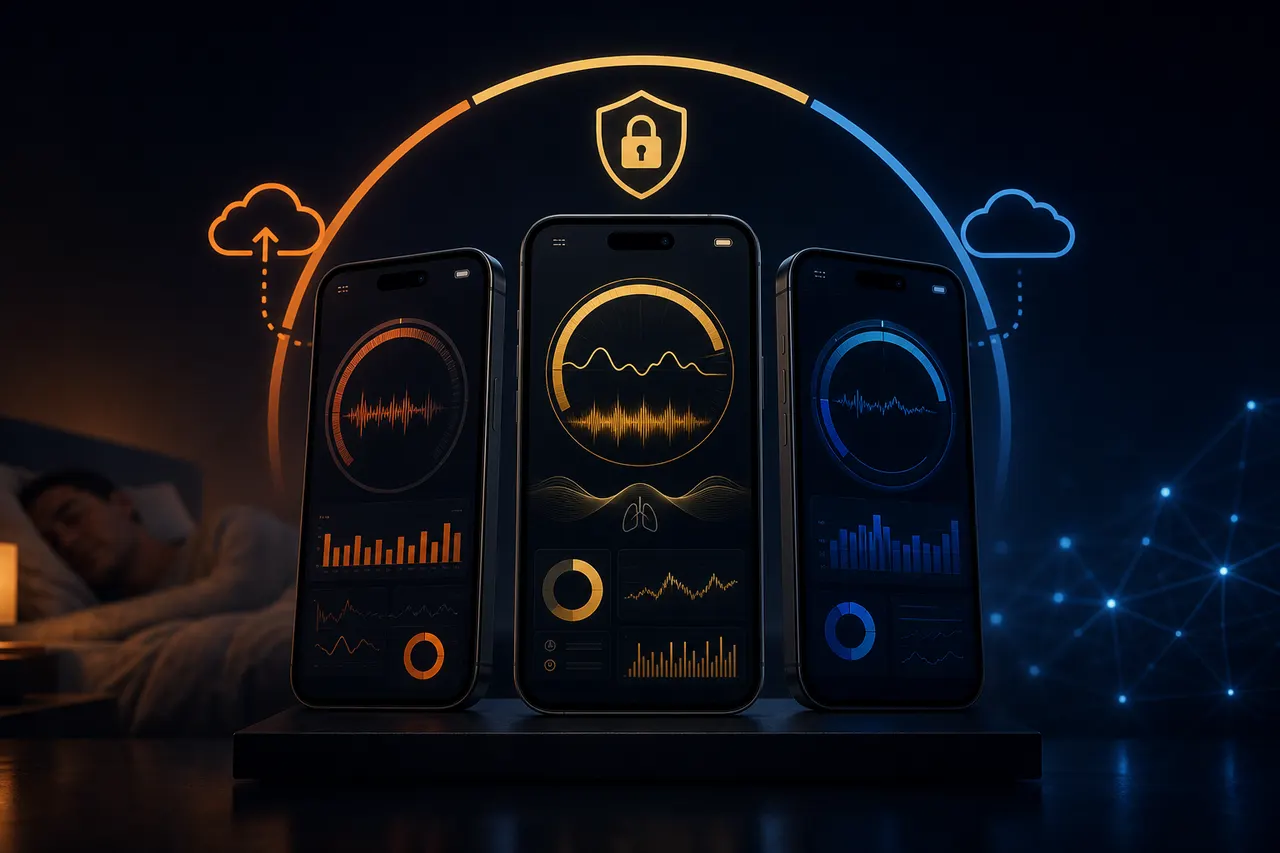
Woken up groggy one too many times? Been told you snore? Or maybe you just want to know what is actually happening while you sleep? Whatever brought you here, you have landed in a market with a few genuinely different options, and in 2026, the differences between iPhone snoring apps go well beyond features.
This comparison covers three apps worth your attention: Nightsong, SnoreLab, and Sleep.ai. By the end, you will have a clear sense of which one fits how you actually want to track your nights.
The Core Difference: Where Your Audio Goes
This is the question to settle first. You are recording yourself sleeping for hours at a time. What happens to that audio?
SnoreLab processes audio on your device but offers an opt-in cloud backup to its own servers. If you enable it, recordings leave your phone. If you do not, they stay local. The choice is yours, but the option exists, which means the default behavior is worth checking.
Sleep.ai is account-based and cloud-connected. Using it means your data moves through Sleep.ai’s own servers. That is a non-issue for plenty of people, but it is a real distinction if privacy matters to you.
Nightsong takes a different position entirely. Its acoustic engine runs on the phone itself, using on-device signal processing to separate breathing and snoring from everything else happening in the room. No audio is streamed, uploaded, or sent anywhere. Every calculation stays on your device. There is no cloud account to create. If you want a snoring app where the audio never leaves your phone, not as a setting you have to find but as the only way the app works, Nightsong is the only option in this comparison that delivers that by design.
How Each App Scores Your Night
Raw audio detection is only useful if the output actually tells you something. Each app takes a different approach to summarizing what happened.
SnoreLab produces a Snore Score: a single number reflecting how much you snored and how loud it was. It is easy to read across nights and measured relative to your own history, which gives it personal context. SnoreLab has been around long enough that its scoring model reflects real-world refinement.
Sleep.ai focuses on sound classification rather than a composite score. It gives you a breakdown of sound events during the night, categorized by type and intensity, which is useful for understanding whether you snore and how often without trying to collapse everything into one number.
Nightsong uses the Somnus Index, a 0 to 100 nightly score that combines two signals: snoring volume and breathing steadiness across the night. That second element is what separates it from a pure snore counter. The score is calibrated against your own 30-day baseline rather than a population average, so a 72 means something specific to your history, not to some aggregate of other users. Over weeks, you can watch that number move and understand what is actually shifting.
Feature-by-Feature Breakdown
Snore Detection and Audio Analysis
All three apps use your iPhone’s microphone. No wearable required, no second device. You place your phone nearby, start a session, and go to sleep.
SnoreLab has a well-established detection model and lets you tag potential causes such as alcohol, exercise, and sleep position to correlate with your scores over time. That contextual tagging is one of its more genuinely useful features for spotting patterns across weeks.
Sleep.ai gives you a visual timeline of the night with classified sound events. It is designed to be approachable, which makes it a reasonable starting point for someone new to sleep tracking.
Nightsong’s acoustic engine treats breathing and snoring as distinct signals rather than just flagging loud events. That separation is what makes breathing steadiness calculable as part of the Somnus Index, a different technical approach rather than just a different label.
Natural-Language Querying
This is where Nightsong stands apart. A feature called Ask Nightsong lets you type plain-language questions about your nights and get answers drawn from your own data. Not a chart to interpret, but an actual answer. You can ask things like “Did I snore more on nights I went to bed late?” or “How has my Somnus Index changed over the past month?” and get a direct response.
Neither SnoreLab nor Sleep.ai offers anything close to this. Both show you data. Neither lets you have a conversation with it.
Apple Watch
Nightsong works with Apple Watch as an optional addition, not a requirement. The core tracking runs entirely on iPhone. If you have a Watch, it can add context, but you do not need one to use the app.
SnoreLab and Sleep.ai are similarly iPhone-first. None of these apps require a wearable.
Android
Nightsong is iPhone only, with no Android release date announced. If you are on Android, SnoreLab supports both platforms.
Pricing
SnoreLab has a free, ad-supported tier that covers basic tracking. Premium runs up to $39.99 per year, unlocking full history, detailed analysis, and data export.
Sleep.ai operates on a subscription model tied to your account. Pricing varies by plan and region.
Nightsong is free to start, with a premium tier at $49.99 per year. The pricing reflects what is included: fully on-device processing, the composite Somnus Index, and the Ask Nightsong natural-language interface. Nightsong is currently in pre-launch, with a waitlist open at nightsong.app.
Who Each App Is Best For
SnoreLab is a strong pick if you want a mature, well-tested tracker with a free entry point, cross-platform availability, and the ability to tag lifestyle factors alongside your scores. It has earned its reputation over time.
Sleep.ai suits someone who wants a clean, visual breakdown of their night and does not mind a cloud-connected account. It is accessible and easy to read without much setup.
Nightsong is the right fit if you want a score that reflects more than just snoring, you care that your audio never leaves your phone, and you would rather ask questions about your data than stare at graphs hoping to find the pattern yourself. It is also worth considering if you have tried other apps and found a single snore metric too limited to actually act on.
One important note: Nightsong, like all consumer sleep apps, is a wellness tool. It is not a clinical device and does not diagnose any medical condition. If you have concerns about your sleep health, a qualified medical professional is the right resource.
The Bottom Line
The best snoring app for your iPhone in 2026 depends on what you actually need from it. If privacy is the priority and you want a composite score you can interrogate in plain language, Nightsong is built for exactly that. If you want a proven tracker with a free tier and cross-platform support, SnoreLab is worth trying first. If you want something simple and visual with minimal friction, Sleep.ai covers the basics.
Join the list and learn more at nightsong.app.
Nightsong is a wellness tracker, not a medical device.
Questions people ask
Which snoring app for iPhone keeps my audio most private in 2026?
With Nightsong, your audio never leaves your device. All processing happens on-phone, with no cloud account and no upload path for the audio at all.
What is the Somnus Index and how is it different from SnoreLab's Snore Score?
The Somnus Index is Nightsong's 0 to 100 nightly wellness score. It combines snoring volume and breathing steadiness, measured against your personal 30-day baseline. SnoreLab's Snore Score reflects snoring intensity relative to your own history but does not include a breathing steadiness component.
Do any of these snoring apps work without a wearable?
Yes. Nightsong, SnoreLab, and Sleep.ai all work using only your iPhone's microphone. No Apple Watch or other wearable is required.
Can Nightsong diagnose sleep apnea?
No. Nightsong is a wellness tracking app, not a medical device. It does not diagnose sleep apnea or any other condition. If you have concerns about your breathing during sleep, speak with a doctor.
Is Nightsong available on Android?
No. Nightsong is iPhone only, with no announced Android release date.
How much does Nightsong cost compared to SnoreLab?
Nightsong is free to start, with a premium tier at $49.99 per year. SnoreLab has a free ad-supported tier and a premium plan up to $39.99 per year.
What makes Ask Nightsong different from what other snoring apps offer?
Ask Nightsong lets you type plain-language questions about your sleep data and get direct answers from your own history. Neither SnoreLab nor Sleep.ai offers a comparable natural-language interface. Most apps show you data; Ask Nightsong lets you have a conversation with it.