How a phone can measure a night by itself
The chip that listens locally, the math that turns a night of sound into a few honest numbers, and why on-device changes what privacy means.
Published Updated
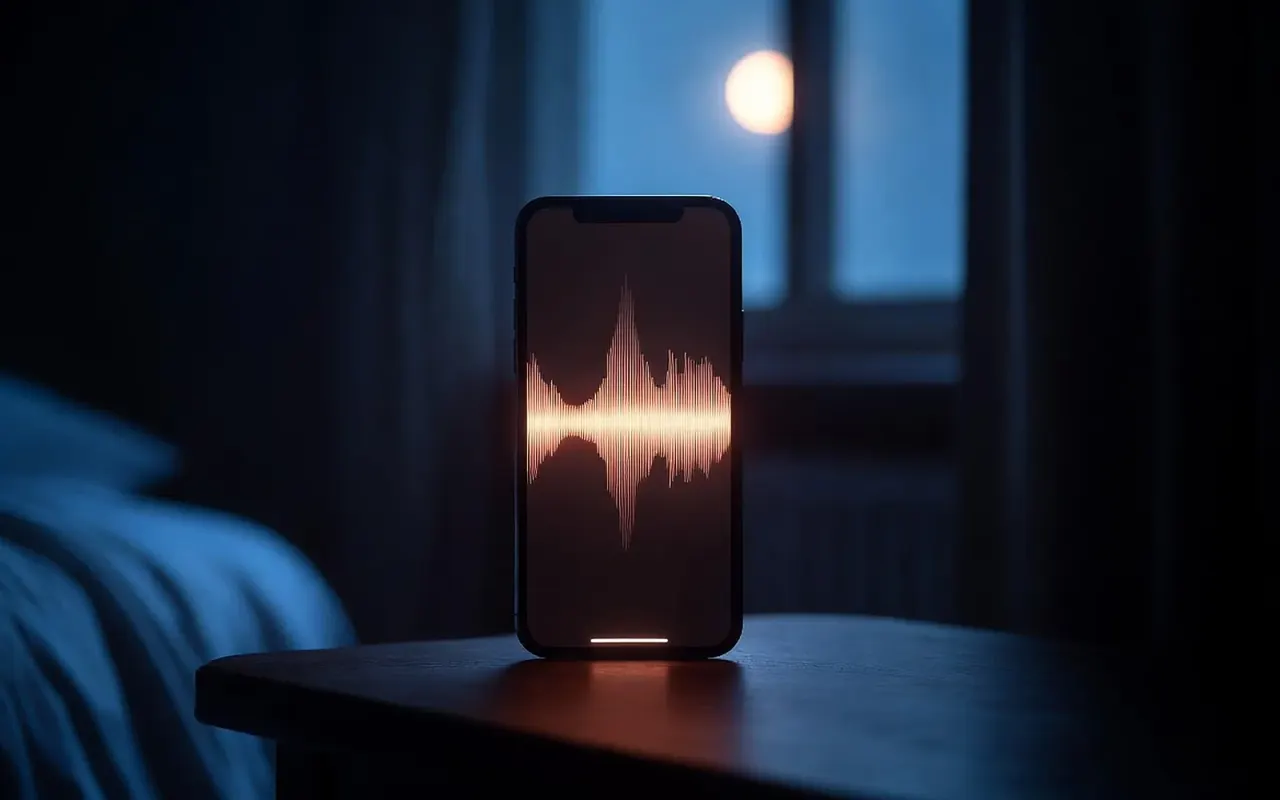
A night has a soundtrack. The steady rhythm of breathing. A stretch of snoring that starts after midnight and fades when you turn over. The turn itself, a rustle of fabric. The furnace cycling. A car passing at 3 am.
Most of that soundtrack is deeply ordinary, and some of it is deeply personal. It is the sound of you, unguarded, for 8 hours, in the most private room you have. Anyone who proposes to measure it owes you a clear answer about where the sound goes.
For most of history, the only way to study a night of audio was to record it and carry the recording somewhere with more computing power. That era is over, and the reason is a piece of hardware that has been sitting in your pocket for years. This piece is about that hardware, the math it runs, and why “where does the sound go” can now have the shortest possible answer: nowhere.
The chip built for patterns
Modern iPhones carry a processor section built for pattern-recognition math, and it has shipped in every iPhone since 2017. Android makers build equivalents. It exists because recognizing patterns, in images, speech, and sound, uses a particular kind of arithmetic, and a chip shaped for that arithmetic runs it hundreds of times more efficiently than a general processor.
Efficiency is the point. It means a phone can run recognition math continuously, for hours, on battery, without a network connection, while the rest of the phone sleeps.
You already use this every day. When your phone wakes to a spoken phrase, a small recognition model running locally was listening for that one pattern the whole time, awake through every quiet hour, acting only on a match. When dictation works in airplane mode, speech is becoming text entirely on the device, and the platform’s own settings say so plainly. Face unlock does the same trick with light instead of sound.
These are shipped, boring, everyday features, and their boringness is the argument. Nobody considers it futuristic that a phone recognizes its wake phrase by itself anymore. The same class of hardware and math, pointed at a bedroom instead of a wake word, is all that night measurement requires.
From a night of sound to a few numbers
So what does the math actually do with a night?
Think of the soundtrack as hours of audio arriving moment by moment. As each moment arrives, the recognition model asks simple questions about it. Does this match the pattern of breathing? Of snoring? How loud, and for how long? Each answer is tiny: a label, a duration, a loudness level.
The moment is analyzed the moment it happens. What accumulates through the night is a running tally: how many minutes of snoring, how steady the breathing rhythm held, how the loudness distributed. By morning, 8 hours of sound have been reduced to a handful of honest numbers, computed by the same class of chip that was going to sit there charging anyway.
That reduction is the whole trick. The numbers are what the Index needs, and the numbers are a few bytes. The clips you can replay stay on your phone and clear after 7 nights.
The scale of the reduction is worth making concrete. A night of audio is on the order of hundreds of megabytes. The morning summary is smaller than this sentence. Everything private about the recording, the voices and the particulars, stays on the phone.
The math comes to the audio, so the audio never has to travel to the math.
What on-device changes about privacy
Now the part that changes the stakes. When the analysis happens on the phone, the recording does not need to go anywhere. And when audio is analyzed on the device, a whole category of problems stops existing.
There is no copy of your night on a company server, which means there is nothing there to breach, nothing to sell, nothing to subpoena, and nothing to lose. There is no privacy policy interpretation that touches your audio in the cloud, because there is no audio in any cloud. The question “who else can hear my bedroom” has a structural answer instead of a promised one: nobody, because it never went anywhere.
Compare the 2 architectures honestly. Cloud processing can be run responsibly, with encryption and access controls and audits, and plenty of companies do. But every one of those protections is a promise maintained by people, renewed through every acquisition, breach report, and terms update. On-device processing replaces the entire stack of promises with a fact about where the computation happened.
Even the platform makers frame it this way. Android’s own developer guidance notes that local processing removes the need to send sensitive data over the network at all. Apple’s dictation settings state plainly when audio is processed on the device and not sent to its servers. On-device is the strong form of privacy: the protection is architecture rather than policy.
What Nightsong™ keeps
Nightsong runs exactly this pipeline, all of it on your phone. Your recordings stay on your phone unless you choose to send them. It listens through the night, does the recognition math locally as each moment happens, and keeps the tally.
What exists in the morning: your minutes of snoring, your breathing steadiness, and the single number they roll up into, the Somnus Index™, a 0 to 100 score you can watch move across weeks. Plus your trend, which is where the meaning lives, because your baseline is the only fair comparison a night ever gets.
And the stance underneath the numbers is honesty. The recognition model is smart; a set of plain, fixed checks keeps it honest, throwing out anything that was not loud enough or steady enough to be real. Same night, same number. When it heard 38 minutes, it says 38. Never a flattering guess, and never a fake zero. If it could not clearly hear the night, it shows no number at all.
What Nightsong is, on paper and in fact: a wellness and longevity product. Your own nights, your own baseline, your own trend, nothing more claimed. What it is architecturally: a listener whose memory of the night is a few honest numbers on your own phone.
Notice what the working output is: the tally, never a feed of your bedroom sitting on a server. You own your night, and what leaves the nightstand each morning is a few numbers, never the audio. A tally is enough to draw the only picture that matters, which is where your nights have been heading.
The nightstand was ready
Step back and the situation is quietly funny. For years, the answer to “what happened in my sleep last night” required either a guess or a lot of equipment. Meanwhile a device with a world-class microphone and a chip purpose-built for recognizing sound patterns spent every one of those nights within arm’s reach, charging.
The sensor was on your nightstand all along. All that changed is that the math finally moved in with it. If you have ever wondered what your own snoring really is, or which way your nights have been drifting, the instrument is already there, and nothing it hears has to leave the room.
Further reading
Questions people ask
How can a phone track snoring without sending audio anywhere?
The microphone, the processor, and the math all sit on the same device. Modern iPhones carry a processor section built for pattern-recognition math, and it has shipped in every iPhone since 2017, so the phone can analyze each moment of sound locally as it happens and build a running tally. The recording never has to travel.
What does the phone actually keep by morning?
For the score, a handful of numbers: minutes of snoring, how steady the breathing rhythm held, and how loudness was distributed. A night of audio is hundreds of megabytes; the morning summary is smaller than a sentence. The numbers are what the Index needs. The clips you can replay stay on your phone and clear after 7 nights.
Why does on-device processing matter for privacy?
When audio is analyzed on the device instead of a server, a whole category of problems stops existing: there is no copy of your night on a server to breach, sell, subpoena, or lose. Cloud processing can be done responsibly, but every protection there is a promise maintained by people. On-device replaces the stack of promises with a fact about where the computation happened.
Does Nightsong upload my recording?
No. Your recordings stay on your phone unless you choose to send them. Nightsong runs the whole pipeline on your phone: the listening, the recognition math, and the morning number. If you choose to share, what you share is a few numbers, with no audio. If it could not clearly hear a night, it shows no number rather than a guess.