What Causes Snoring? The Real Physiology Behind It (and How to Track Which Cause Is Yours)
Snoring has seven main causes, most of which shift from night to night. Here is the physiology behind each one, and how to figure out which cause is actually yours.
Published Updated
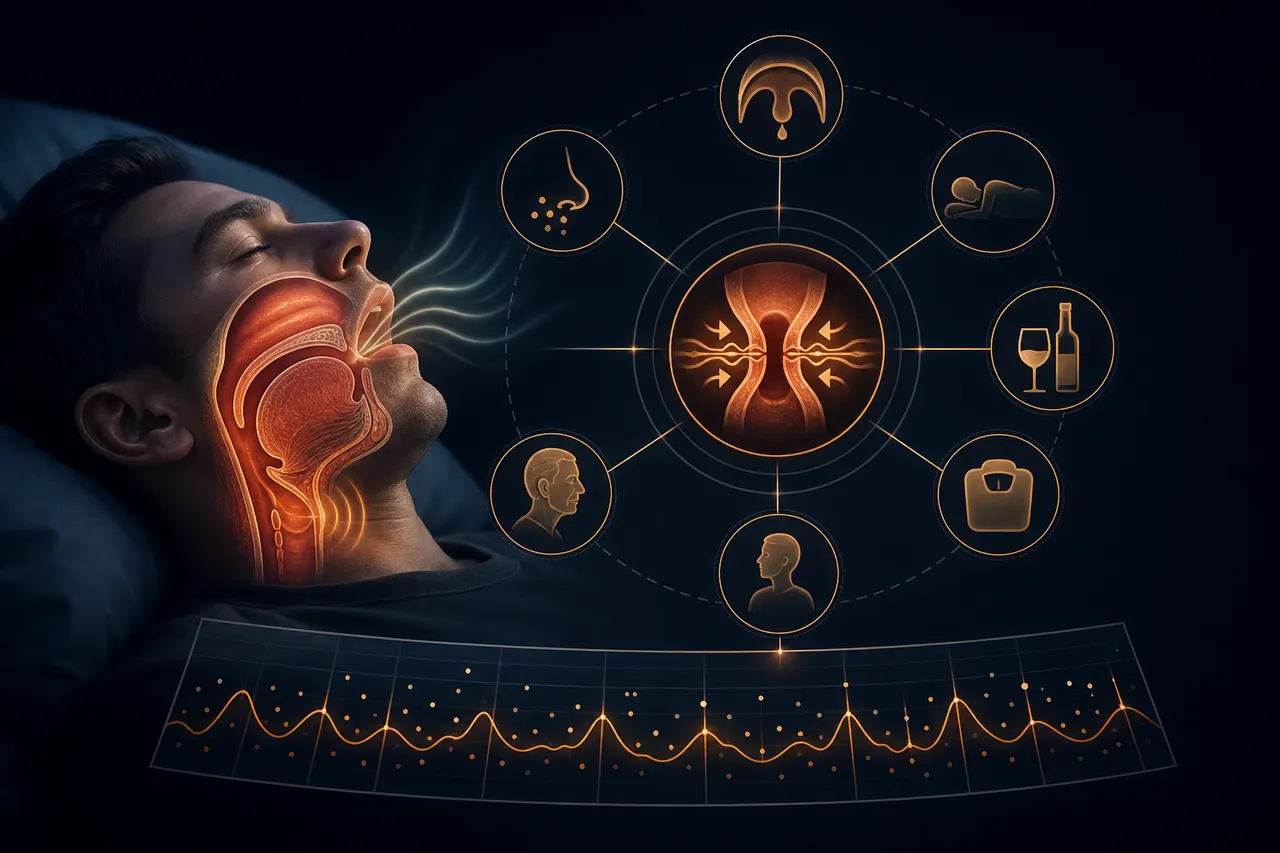
You wake up to a nudge from your partner, or you catch yourself on a recording, and the question sticks: why does this keep happening? Snoring gets treated as a punchline, but the mechanics behind it are worth understanding. Once you know what actually produces the sound, you can start figuring out which cause is yours and whether anything you are trying is genuinely making a difference.
The Basic Mechanics: Why Snoring Happens at All
Snoring is a vibration. When you fall asleep, the muscles in your throat relax, the airway narrows, and air still has to get through. It speeds up through the tighter space, and the surrounding soft tissue (the soft palate, the uvula, the throat walls) starts to flutter.
That flutter is the snore.
The louder and more irregular the sound, the more turbulent the airflow. A quiet, rhythmic snore usually points to mild narrowing. A loud, interrupted, or gasping pattern can suggest more significant obstruction. Snoring apps are not diagnostic tools, and if you suspect something serious, a sleep physician is the right call.
The Main Causes, One by One
Soft Palate and Throat Tissue
The soft palate is the flexible rear portion of the roof of your mouth. When throat muscles relax during sleep, it can drop toward the back of the throat and vibrate as air passes through. People with a longer soft palate or an enlarged uvula have less clearance to begin with, which makes this more likely.
This is the most common anatomical contributor to snoring. It is why some people snore regardless of what they ate or drank that night. The structure is just there.
Nasal Congestion and Obstruction
When your nose is blocked (from allergies, a cold, a deviated septum, or seasonal congestion) you shift to mouth breathing. That bypasses the nose’s natural airflow regulation and routes air directly through the throat, increasing turbulence and the likelihood of tissue vibration.
If your snoring reliably gets worse during allergy season or after a cold, nasal congestion is probably a significant piece of the puzzle.
Sleep Position
Sleeping on your back is one of the most reliable ways to worsen snoring. Gravity pulls the tongue and soft palate backward toward the throat, narrowing the airway further. Side sleeping typically opens things up and reduces that gravitational pull.
Position is one of the more actionable causes because it shifts night to night. You might sleep on your side most of the week, roll onto your back on a restless night, and feel the difference the next morning even if you cannot quite explain why.
Alcohol and Sedatives
Alcohol is a muscle relaxant. Drink in the evening and the muscles in your throat relax more than they normally would during sleep. The airway narrows more. The tissue vibrates more. Even one or two drinks a few hours before bed can meaningfully increase snoring intensity.
Sedative medications work through a similar mechanism. If your snoring seems worse on nights you have had a drink, that connection is almost certainly real.
Body Weight
Excess weight, particularly around the neck and throat, adds soft tissue that presses on the airway from the outside. A larger neck circumference is one of the most consistently documented risk factors for snoring and sleep-disordered breathing. That said, plenty of lean people snore due to anatomy alone. Weight is a genuine contributing factor for many, but not the only one.
Age
Muscle tone decreases throughout the body as you get older, and the throat is no exception. The muscles that hold the airway open during sleep become less taut over time. This is why snoring tends to become more common and louder with age, even without any change in habits or weight.
Anatomy
Some people simply have less airway space to work with. A narrow throat, large tonsils, or a recessed jaw can all reduce the room air has to move through. These structural factors do not change from night to night, but they set the baseline level of vulnerability to everything else on this list.
Why One Night Tells You Almost Nothing
Here is the problem with trying to identify your snoring cause from a single night: most of the causes above vary constantly.
You might sleep on your side Monday and your back Tuesday. Have a glass of wine Wednesday. Your allergies flare Thursday. Each of those nights produces a different result. With only one data point, you cannot separate signal from noise.
This is why a trend across many nights matters far more than any single recording. If you change one thing (say, you stop drinking on weeknights) you need enough nights of data before and after to see whether that change actually moved your snoring pattern. One good night following a habit change might just be coincidence. The research backs the patience: a Journal of Sleep Research study on recording length (Van Someren, 2007) found that a reliable read on someone’s rhythm takes more than 7 nights, and the Chest trial of snoring exercises (Ieto and colleagues, 2015) ran a full 3 months before scoring the result.
Tracking Which Cause Is Yours
The practical approach is to build a personal baseline and watch how it shifts when specific variables change.
That is the core idea behind Nightsong. It uses your iPhone’s microphone and on-device signal processing to separate your breathing and snoring sounds from a full night of ambient noise. No audio is uploaded. No cloud account. No wearable.
Each morning you get the Somnus Index, a 0 to 100 score built from how steady your breathing was and how much you snored, measured against your own baseline rather than a population average. Over 30 days, patterns start to emerge: does your score dip after alcohol? Improve when you sleep on your side? Track with your allergy symptoms?
You can also ask plain-language questions about your nights and get answers drawn directly from your own data. Was last week worse than the week before? Did your score change after you started using a nasal strip? The answers come from your history, not a generic algorithm.
Nightsong is currently pre-launch, with a waitlist open at nightsong.app.
A Note on When to See a Doctor
Tracking snoring patterns is useful for understanding everyday variation and measuring whether lifestyle changes are helping. It is not a substitute for medical evaluation.
If your snoring is loud and frequent, if you wake up gasping, if you feel unrefreshed after a full night of sleep, or if a partner has noticed you stop breathing during the night, those are reasons to speak with a sleep physician. Sleep apnea is a medical condition that requires clinical diagnosis and treatment well beyond lifestyle adjustments.
The Short Version
Snoring happens when the airway narrows and soft tissue vibrates. The main contributors are anatomy, soft palate structure, nasal congestion, sleep position, alcohol, body weight, and age. Most of these shift from night to night, which means a single recording tells you very little. A consistent trend across weeks, measured against your own baseline, is what actually reveals which cause is yours and whether what you are doing about it is working.
Questions people ask
What physically causes the sound of snoring?
Snoring is the sound of soft tissue in the throat vibrating as air passes through a narrowed airway. When throat muscles relax during sleep, the soft palate, uvula, and throat walls can flutter against each other, producing the characteristic sound.
Does sleeping position really affect snoring?
Yes. Sleeping on your back allows gravity to pull the tongue and soft palate toward the back of the throat, narrowing the airway. Side sleeping typically reduces this effect and is one of the most commonly recommended positional adjustments.
Why does alcohol make snoring worse?
Alcohol relaxes muscles throughout the body, including in the throat. That extra relaxation narrows the airway more than usual, increases tissue vibration, and tends to make snoring louder and more frequent.
Can nasal congestion cause snoring even if I do not usually snore?
Yes. When nasal passages are blocked, you shift to mouth breathing, which routes air directly through the throat with less regulation. This increases turbulence and can trigger snoring in people who otherwise sleep quietly.
How many nights of data do I need to see a meaningful pattern?
There is no universal number, but sleep measurement research points to at least two to four weeks of consistent data before drawing conclusions about a habit change. Single nights are too variable to be informative on their own.
Is snoring always a sign of sleep apnea?
No. Many people snore without having sleep apnea. However, loud, frequent snoring combined with gasping, choking, or daytime fatigue can be associated with sleep-disordered breathing and warrants evaluation by a sleep physician.
Can I track my snoring without a wearable device?
Yes. Nightsong uses your iPhone's built-in microphone and on-device processing to monitor breathing and snoring sounds overnight. No wearable, no second device, and no audio ever leaves the phone.